
Top 3 reasons why your red line (non-showdown winnings) is dropping
What is the red line and why it impacts your profit so heavily
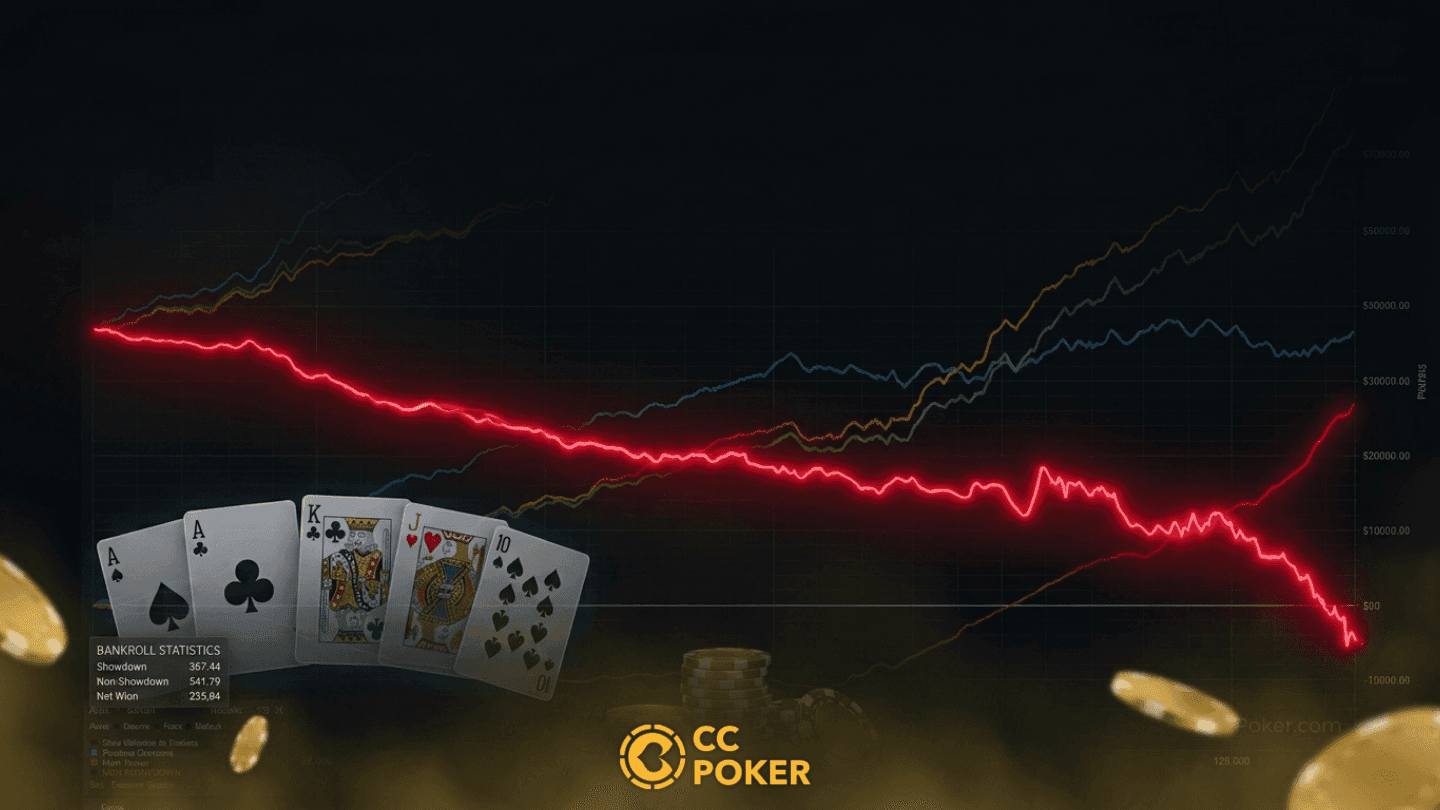
The red line represents non-showdown winnings. It shows how much money you win in hands where cards are never shown. The blue line is showdown winnings, and the green line is your total profit.
Many players open their graph and see that their green line barely grows while the red line plummets downward. A negative red line is not a death sentence. It depends heavily on playstyle, limit, and specific field dynamics. So what is happening, what are the causes, and how do you fix it?
How the red line works mechanically
The mechanics of the red line are very simple and concrete:
✅ When you fold before showdown (preflop, flop, turn, or river) — your red line drops. You lose money you already invested in the pot.
✅ When you bet or raise and your opponent folds — your red line rises. You take the entire pot without showing your cards.
That's the whole mechanism. It doesn't matter whether you were bluffing or holding a monster — if the hand ends without a showdown and the pot goes to you, your red line goes up. If the pot leaves you without a showdown, it goes down.
Blinds affect it most severely. You are forced to invest money every orbit (small and big blind). If you frequently fold preflop or play passively postflop from the blinds, every fold hits your red line directly.
That is why most players' red lines look worst when out of the blinds.
Reason #1. Passive blind defense
Every fold from the blinds is a blow to your red line because the money is already in the pot. Why does passive calling create a massive non-showdown leak, and how do expanded 3-bets plus check-raises with draws reverse the trend?
Why a passive call from the blinds guaranteed drops your red line
Your red line drops every time you fold, and you fold from the blinds very frequently.
Open your tracker and check your graph by position. You will almost certainly see a pattern: from the button, cutoff, and even middle positions, your red line is acceptable. But in the blinds, it's a sheer drop. This is where the lion's share of non-showdown money bleeds away.
The problem is defending blinds improperly preflop. Calling with hands like A5s, K9s, and 76s from the big blind seems safe — after all, you're playing a hand. But over a long sample, it's a huge leak. Here is why:
▶️ You rarely hit the flop. Suited connectors only realize equity when ideal board textures hit, which is a minority of the time.
▶️ You almost always play out of position. Realizing equity out of position is far more difficult. Your opponent bets when you miss and checks when you hit. You don't control the pot size.
▶️ Every preflop fold from the BB drops your red line, because 1 BB is already in the pot. It's lost money. If you fold 80% of hands from the big blind, your red line dies simply from the sheer volume of folds.
Most regs at micro and mid-stakes have terrible blind graphs simply because they defend passively preflop and constantly fold postflop.
Real-world example
You are on the BB with 7♠ 6♠. BTN opens to 2.5 BB.
❌ Passive line (Call). Flop K♣ 9♦ 2♥. You miss, the opponent c-bets, you fold. As a result, you lost 1 BB preflop and failed to realize any equity. Red line drops.
✅ Aggressive line (3-bet). You 3-bet to 10 BB. The opponent folds. You claim the pot immediately without showdown or postflop risks. Red line rises.
According to renowned poker pro Nathan Williams (BlackRain79), playing marginal hands via a 3-bet yields 5 to 6 times more profit than passive calling (+60 bb/100 vs +9.5 bb/100). The lion's share of this profit comes directly from non-showdown winnings.
Expanding 3-bets and adding check-raises
Solution #1 is 3-betting from the blinds with a wide range. Instead of calling with suited aces, connectors, and suited broadways — 3-bet them. This generates preflop fold equity (winning the pot immediately without a showdown — red line) and gives you postflop initiative.
Your overall 3-bet frequency from the big blind should be around 11%. Broken down by opponent position:
➕ vs UTG: 6%.
➕ vs MP: 8%.
➕ vs CO: 10%.
➕ vs BTN: 15%.
➕ Blind vs blind (SB vs BB): 18%.
If your BB 3-bet frequency is currently around 5–7%, you are playing too passively, and your red line confirms it.
Why such a difference in profit? Because a 3-bet forces your opponent to fold, and every fold is money added to your red line. Plus, even if they call, you retain initiative and can continue pressure postflop.
Check-raising with draws on the flop
Suppose you defend your blind with a call, and flop a flush draw or straight draw. The opponent c-bets. What do most players do? They call. Then, if they miss on the turn, they fold to a second barrel. And the red line keeps dropping.
Try check-raising. Yes, it's more aggressive. Yes, you risk more. But you gain two ways to win the pot:
✅ The opponent folds immediately (especially if their c-bet was a standard automatic bet with air).
✅ You get a chance to take down the pot on the turn or river if you complete your draw.
Check-calling draws OOP = red line down, overall win rate in the red. Check-raising draws = red line up, overall win rate near break-even or in the green.
Reason #2. Chronic overfolding
Fit-or-fold is the go-to strategy of those who ruin their red line. Folding to c-bets without a pair, folding to second barrels without improvement, folding on the river without the nuts. Why fold hands you are mathematically obligated to defend?
Fit-or-fold
Fit-or-fold means folding everything that misses the flop. No pair? Fold. No draw? Fold. This is the single most common issue for players from NL2 up to NL400.
For instance, an opponent bets 33% of the pot on the flop. You hold a hand with 40% equity. Mathematically, you must call — your pot odds are great. But you fold. Why? Because you didn't hit or don't have a pair.
Suppose you are in the small blind vs the big blind in a single-raised pot. The flop comes, and the opponent bets a small 33% pot size.
Solvers indicate that you should only fold 19% of your hands here. That means 81% of your range must be defended by calling or raising.
What does the average player do? They fold 33% of their hands. The gap is massive. Players overfold hands that math dictates they must defend.
The same story happens on the river. Solvers fold 48% against a 3/4 pot bet. Regs fold far more often out of fear of making a mistake or calling down with the worst hand. As a result, they overfold significantly.
Why does this kill the red line?
Every time you fold, your red line drops. Fold to a c-bet when you miss — red line goes down. Fold to a second barrel when you don't improve — same result. Fold on the river without the nuts — down again.
The reason is simple: defending correctly is hard.
It requires skill, mathematical understanding, and opponent reading abilities.
How to fix this
Here are three proven solutions to plug this leak.
Reason #3. Missed opportunities for aggression
You play disciplined poker without major mistakes, yet you rarely exert real pressure on your opponents. As a result, small and medium pots constantly slip away.
Why this happens:
✅ Overly tight open-raising and stealing ranges from late positions.
✅ Infrequent c-bets, second barrels, and floats.
✅ Lack of semi-bluffs with draws.
✅ Fear of thin value-betting or bluffing in advantageous spots.
✅ Lack of multi-street planning.
As a result, you claim fewer non-showdown pots than you should. Opponents freely realize their equity, driving your red line into negative territory.
How to fix this is detailed in the table.
A healthy red line comes down to spot quality. Top players bluff and value-bet more in situations where their opponent's range is weak, and less when it's strong.
By applying conscious aggression in these exact scenarios, your red line will quickly stabilize and start trending upward.
Timing tells for the red line
One of the most underrated tools for boosting your red line is timing tells.
If an opponent takes longer than usual (typically over 9–10 seconds) before making a preflop raise or 3-bet, they fold significantly more often to a 3-bet or 4-bet.
Tanking preflop usually indicates a weak or marginal hand. The player hesitates out of uncertainty. In these moments, you can aggressively ramp up pressure — their fold frequency spikes noticeably.
How to use it:
▶️ Increase your 3-bet and 4-bet frequency specifically against preflop tankers.
▶️ Build a habit of tracking opponent decision times.
Over a sample, timing tells generate massive red line gains with virtually no risk to your blue line.
Conclusion
The red line reflects aggression, discipline, and your ability to claim pots without a showdown. If it's falling, the issue almost always stems from passive blind defense, overfolding, or missed opportunities for pressure.
Plug even one of these leaks and you'll immediately notice a shift in your game. Small and medium pots will stay with you more often, pushing your overall green line steadily higher.
The golden rule remains: you can only withdraw the green line. But a healthy red line keeps your win rate stable and your sessions far more profitable.




Last news
.png&w=640&q=75)
How to defend blinds (SB and BB) correctly: Stop giving away money

Poker digest: Asian super high roller, PLO5/6 boom, and autumn series peak

Poker digest: Main events of rooms, club unions, and apps
%2520%25D0%259E%25D0%25B1%25D0%25B7%25D0%25BE%25D1%2580.png&w=640&q=75)
Black chip poker (WPN): Review of rake, "The beast" promos, and cash game options
Similar articles
.png&w=1920&q=75)
How to defend blinds (SB and BB) correctly: Stop giving away money
Blind defense strategy for SB and BB ➥ learn how to stop losing chips preflop and defend your blinds profitably against aggressive open-raises.
%2520%25D0%259E%25D0%25B1%25D0%25B7%25D0%25BE%25D1%2580.png&w=1920&q=75)
Black chip poker (WPN): Review of rake, "The beast" promos, and cash game options
Complete Black Chip Poker WPN review: rake, The Beast race & cash games ➥ Discover USA traffic, bonuses, and poker software today!
.png&w=1920&q=75)
Poker for the chosen or how to stop feeding regulars and start making money
Learn why open poker rooms are flooded with tough regulars and how to achieve consistent profits in private poker club apps with CC-Poker.